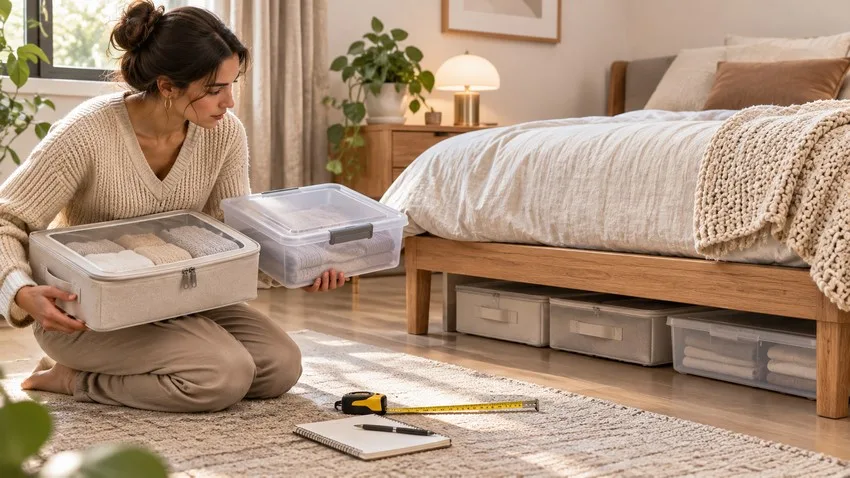
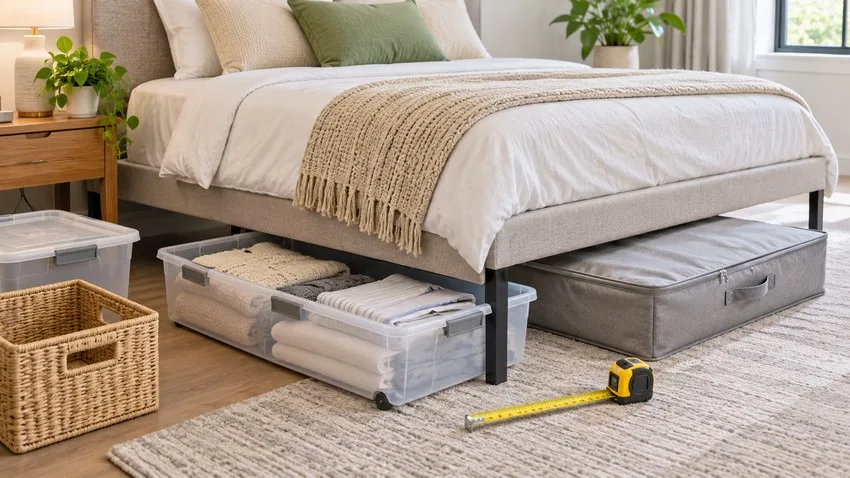
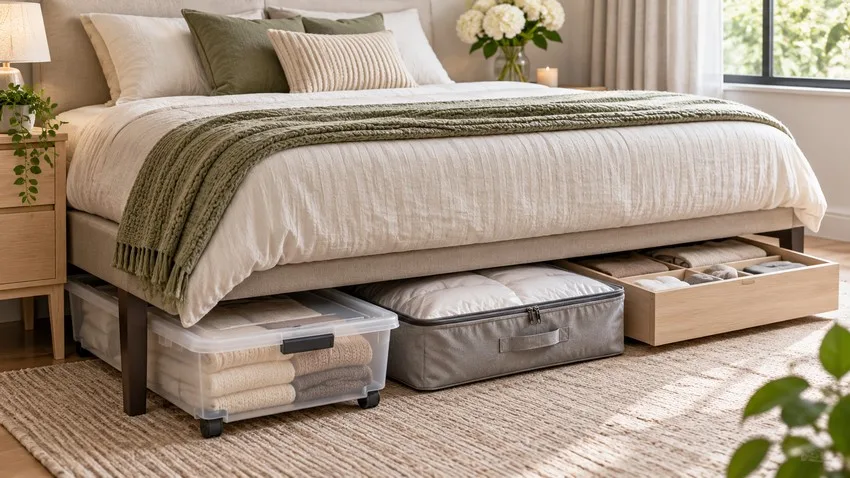
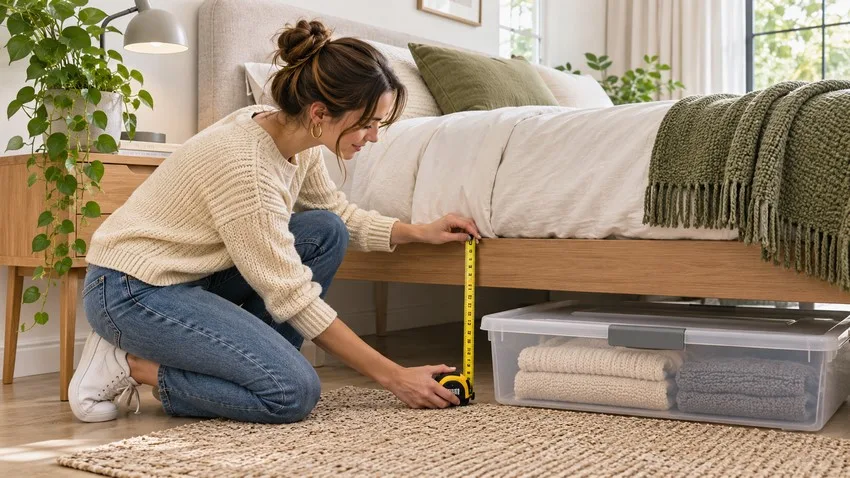
To choose under-bed storage that fits, measure three things: the lowest opening under the bed frame, the usable space between support legs, and the floor space needed to pull the container out. Compare those measurements with the container’s complete external dimensions, including its lid, handles and wheels.
A box can fit beneath the mattress and still be impossible to slide past a side rail or open beside a nightstand. Start with the route the container will take, then choose the storage type.
1. Measure the opening, not the mattress height
Use a tape measure to check the distance from the floor to the lowest fixed obstruction along the side or foot of the bed where you plan to insert the container. That obstruction might be the side rail, a crossbar or part of the frame.
Measure several points along the route. If a box has to pass under a low rail before reaching a taller space, the rail determines whether it can enter.
Measure from the actual surface. Include any rug or carpet beneath the container.
Check the middle of the bed. Center legs and crossbars can divide one large space into smaller storage bays.
Look for moving parts. Keep storage outside the operating area of adjustable or lift-up mechanisms. Follow the bed manufacturer’s instructions.
Choose a container shorter than the smallest opening so it can move without scraping. There is no single clearance allowance that works for every bed: carpet, uneven floors and a soft bag’s loaded shape can change the fit. If the measurements are close, test with a cardboard mock-up before ordering.
2. Map the space between the bed’s supports
Do not use the mattress size as the storage footprint. A queen-size bed, for example, does not provide an uninterrupted queen-size rectangle beneath it. Legs, rails and other supports reduce the usable area.
For each accessible bay, record its width and depth. Note whether you can approach it from the side, the foot of the bed, or both. A simple sketch is enough.
Measurement
Where to check
What it tells you
Entry height
Floor to the lowest obstruction on the insertion route
The maximum height the container must clear
Usable width
Between legs or other fixed supports
Whether the container can enter the bay
Usable depth
From the entry side to the next obstruction
How far the container can slide beneath the bed
Retrieval space
From the bed edge to nearby furniture or a wall
How far you can pull it out
Opening space
Above and around the lid or zipper when retrieved
Whether you can reach the contents comfortably
Painter’s tape can help mark a proposed footprint on the floor. Check the tape on an inconspicuous area first, and avoid applying it to delicate finishes.
3. Compare external dimensions, not capacity
Liters and quarts describe capacity; they do not tell you whether a container will fit. Two boxes with similar capacities can have different heights and footprints.
Look for assembled external dimensions. Product listings may also show internal dimensions, folded dimensions or packaging measurements. These are useful for other purposes but cannot replace the size of the complete container.
Before ordering, check:
Whether the stated height includes the lid and wheels.
Whether handles, latches or a flared rim extend beyond the main body.
Which measurement is length and which is width; follow the product’s dimension diagram.
Whether a fabric bag keeps its advertised shape when filled.
Do not add wheel height a second time if it is already included in the assembled measurement. If the listing is unclear, ask the manufacturer or seller.
A worked example
Suppose your entry opening is 7 inches high (about 17.8 cm), and a rigid box measures 6 inches high (about 15.2 cm), including its lid and wheels. That leaves a nominal 1-inch gap (about 2.5 cm). You still need to check the box’s width, depth and route past the support legs.
Now suppose the box extends 28 inches (about 71.1 cm) into the bed, but the aisle beside it is only 20 inches wide (about 50.8 cm). You cannot pull it straight out completely into that aisle. A lid that opens while the box is partly retrieved might help, but only if you can actually reach the contents.
These are hypothetical measurements to demonstrate the checks, not standard bed dimensions or a universal clearance recommendation.
4. Choose between bags, bins and drawers
Choose the format around what you store and how often you need it. The largest container is not always the easiest to use.
Storage type
Useful for
Main trade-off
Check before buying
Zippered fabric bag
Seasonal clothing and spare linens
Flexible sides can bulge or sag when filled
Loaded height, handle construction and care instructions
Rigid plastic bin with lid
Grouped items that benefit from a defined shape
The rim and lid may make it larger than expected
External dimensions, closure and opening space
Rolling box or drawer
Items you retrieve regularly
Wheels need a suitable surface and a clear route
Assembled height, wheel direction and floor compatibility
Divided shoe organizer
Keeping pairs separated
Compartments may not accommodate larger shoes or boots
Individual compartment dimensions and cover access
Vacuum storage bag
Textiles whose care instructions permit compression
It needs resealing after access and may change shape
Textile care guidance, valve access and compressed dimensions
A fabric cover, a zip or a clip-on lid does not automatically mean a container is airtight, waterproof or pest-proof. Look for an explicit product specification if you need a particular level of protection.
5. Match the container to your floor and access needs
On carpet
Check whether the manufacturer describes the wheels as suitable for your floor type. Small casters may be difficult to move through deep carpet, so a box labeled “rolling” is not enough information on its own. Try a single unit before buying a matching set if performance is uncertain.
On hard flooring
Check the contact points and keep grit out of the retrieval path. Wheels, feet and the underside of a dragged container can mark a finish if debris becomes trapped beneath them. Avoid assuming that every plastic base is safe to slide.
In a narrow room
Consider smaller containers that can be retrieved individually. Check whether a hinged or split lid opens without removing the whole box. A long container with a fully removable lid may be awkward beside a wardrobe, even when it fits under the bed.
For frequent access, place labels and handles on the reachable edge. Put occasional-use items farther back only if you can still retrieve them without moving the bed.
6. Store items that suit the space
Clean, fully dry seasonal clothing, spare sheets and occasional-use accessories are sensible starting points. Group items by purpose so you do not have to empty several containers to find one thing.
Bedding: check the filled container’s shape before sliding it beneath the frame.
Shoes: clean and dry them first; verify compartment sizes for the pairs you own.
Small accessories: use dividers or smaller pouches to keep them together.
Heavy items: stay within the container’s stated load limit and keep the filled unit manageable for you.
Do not use a sealed box as a remedy for a damp room, and do not pack damp textiles away. Keep floor vents, cables, bed mechanisms and access needed for cleaning clear.
If storage only fits after changing the bed’s supports, stop and consult the bed manufacturer. Do not remove center legs or other structural parts to make room for a container.
Before you order: a quick fit checklist
I measured the lowest opening along the entire insertion route.
I checked the width and depth between support legs.
I used assembled external dimensions, including protruding parts.
I left a practical movement gap rather than choosing an exact-height fit.
I can pull the container out far enough to open it.
The wheels or base suit my flooring.
The filled container will be manageable to move.
The contents are suitable for the space and their care instructions.
If a measurement is borderline, make a cardboard mock-up of the container’s outside dimensions. Slide it along the proposed route and check access before committing to a set.
Frequently asked questions
How much clearance do you need for under-bed storage?
Enough for the complete container to pass the lowest obstruction and move without scraping. Measure your bed and compare it with the assembled product dimensions. A universal minimum is not reliable because frames, floors and containers vary.
Are fabric bags or plastic bins better?
Fabric bags can suit soft seasonal items when flexibility is useful. Rigid bins provide a defined shape and may be easier to organize internally. Compare the individual product’s closure, dimensions and handling rather than assuming one material is always better.
Can you use under-bed storage on carpet?
Yes, if the container can move on your carpet and still clear the frame. Check wheel suitability and test the retrieval route. A box that works on smooth flooring may be harder to move on a thick pile.
What if a box fits underneath but will not come out?
Check for support legs, nearby furniture and insufficient aisle space. You may need a shorter container, several smaller units or a different access direction. Do not alter the bed’s structural supports.