Choose a dish drying rack for a small kitchen by checking its usable footprint, where the water drains and whether it holds your normal washing-up load. Include any cup holders, utensil baskets and drain spout in the fit check. A rack that fits beside the sink can still leave too little space to prepare food.
The best design for your kitchen may be a compact countertop rack, a folding model you put away or a rack supported over the sink. Each saves space in a different way. Start with your routine and the available working area, rather than the smallest dimensions in a product listing.
If you shop on UK sites, you may see the same category described as a dish drainer. Check the actual construction and dimensions regardless of the name.
1. Decide how much drying space you actually need
Look at what you hand-wash after a normal meal. A few mugs and plates need a different layout from mixing bowls, food containers and a frying pan. If you use a dishwasher, your rack may mainly need to handle the items you wash separately.
Write down the pieces that are awkward to place: a wide dinner plate, a tall bottle, a saucepan lid or a large cutting board. Then check whether the rack has a supported position for them. A claim such as “holds ten plates” says little about room for bowls or cookware.
Also decide whether the rack will stay out all day. A small permanent rack may suit frequent washing, while a folding design may be more useful when you want the counter clear between meals. Folding only helps if you have somewhere to store the dry rack afterward.
2. Measure the working area around the sink
Measure the counter section you can give up without blocking your main preparation area. Include space for the faucet, soap dispenser and anything that must remain accessible.
Width and depth: use the complete assembled dimensions, including projecting holders and the drain tray.
Height when loaded: check your tallest plate or utensil beneath cabinets and shelves.
Faucet movement: allow room to turn the handle and move a swivel or pull-out faucet as intended.
Drainage route: check the distance and height between the rack’s outlet and the sink edge.
Everyday access: make sure the rack does not block a window handle, drawer or appliance you use.
Mark the proposed footprint with a sheet of paper or cardboard on a dry counter. Stand at the sink and imagine loading plates, reaching for the faucet and preparing food beside it. This will not prove stability, but it can reveal an inconvenient layout before you order.
3. Compare the main dish rack designs
Choose the type around the space you can use
Design
When to consider it
Main trade-off
Compact countertop rack
You have a permanent space beside the sink and wash small loads regularly
Occupies preparation space even when empty
Folding countertop rack
You want to clear the counter between uses
Needs a dry storage spot and enough space when fully opened
Rack supported across the sink
Your sink has suitable support edges and you can spare part of the bowl
Reduces sink access and must match the supported span
Roll-up rack over the sink
You need a removable surface for suitable small loads
Often lacks dedicated upright plate slots; check support and load limits
Tall rack above the sink
There is clear vertical space and a suitable supporting surface
Needs careful checks for faucet, cabinet and window clearance
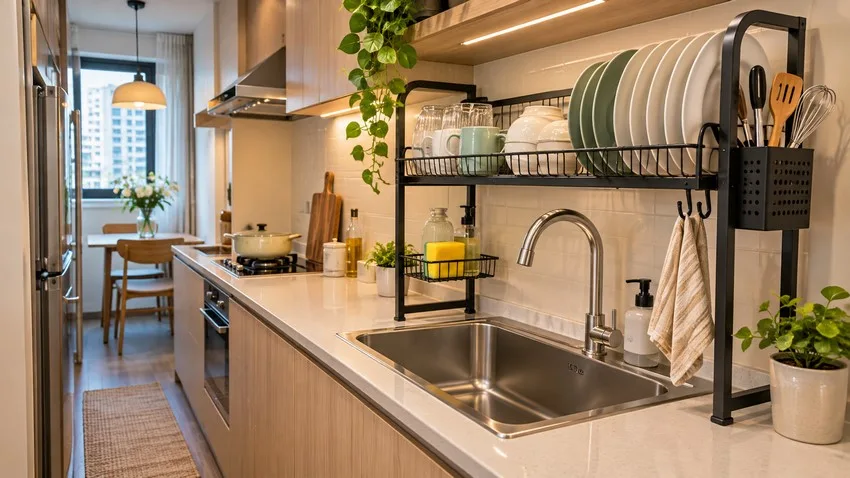
“Over-sink” can describe very different products. A low rack bridging the bowl and a freestanding shelf above the faucet should not be assessed using the same measurements.
4. Check where the water will go
Direct-drain racks
A drain spout must reach the sink in the position where the rack actually fits. Check its direction, reach and clearance over the rim. A raised sink edge may interrupt a route that looks straightforward in a product photo.
Some designs have a movable spout. For example, simplehuman describes a pivoting, removable spout on its steel-frame dishrack. That illustrates a feature to check, not a guarantee that the rack will suit your sink.
Include water from external cup holders and utensil baskets in your assessment. If they project beyond the collecting tray, drips may fall onto the counter instead.
Collecting trays and drying mats
A tray without direct drainage needs to be emptied and cleaned. Check whether you can remove it easily or must unload the entire rack first. A mat needs space to dry between uses and care according to its label.
Neither a tray nor a mat should be treated as a reason to leave the counter underneath unchecked. Follow your countertop’s care instructions, particularly around joints and the sink cutout.
5. Check capacity using your own dishes
Compare the plate supports with the size and shape of your dinnerware. Deep bowls need a different arrangement from flat plates, and thick rims may not suit narrow slots. Look for product photos that show items similar to yours.
Consider where the heavier items will sit. Follow the rack’s stated load limit and loading instructions rather than balancing a pan across narrow supports. External holders also need checking: a tall glass or bottle should sit securely in a position intended for it.
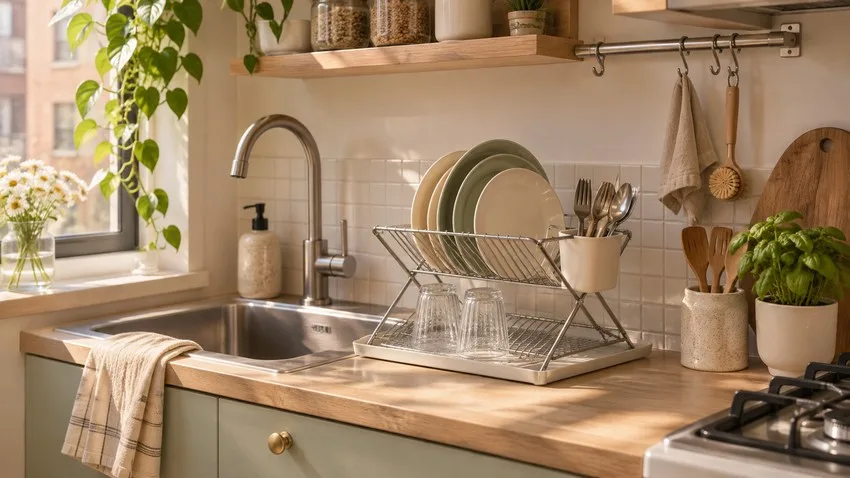
For a folding rack, inspect how the layout changes between configurations. OXO’s Foldaway model, for example, has a plate section that folds down for larger items. A convertible layout can be useful, but only if it accommodates the combination of items you wash together.
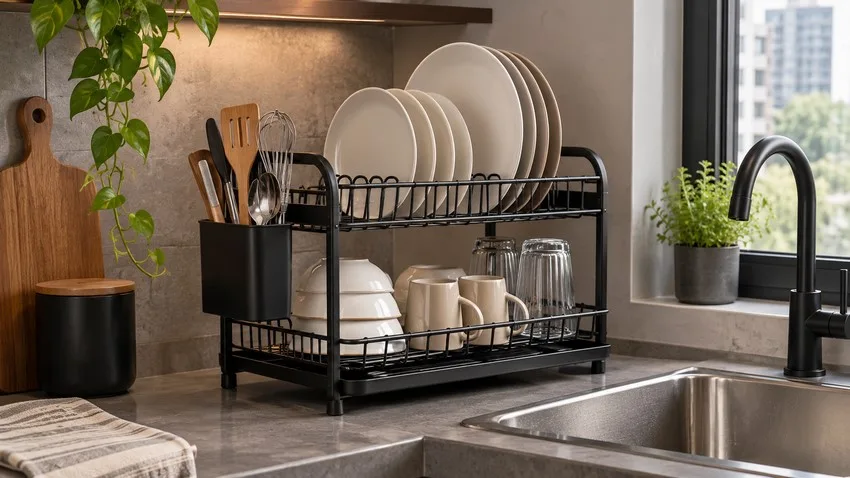
Do not buy extra tiers simply because they promise more capacity. Check whether you can reach the lower level, whether tall dishes fit and where water from the upper level lands.
6. For over-sink designs, check support and sink access
Measure the span in the direction the rack will bridge. Compare it with the manufacturer’s supported sink dimensions and minimum bearing area. An adjustable overall length does not mean every point in its extension range is suitable for every sink.
Check that both ends rest securely on the intended surfaces. A curved rim, narrow ledge or nearby faucet fitting may prevent a proper fit. Follow the product instructions and avoid improvised supports.
Then consider the sink in use. Can you rinse a pan, fill a kettle and reach the drain without repeatedly moving loaded dishes? In a single-bowl sink, losing part of the opening may be a larger inconvenience than giving up a small area of counter.
For tall above-sink racks, measure the full height with dishes loaded and check the base footprint. Keep the faucet, window and cabinet doors usable. Do not assume that a rack marketed for “small kitchens” has a small working envelope.
7. Choose a rack you can clean easily
Look beyond the frame material. Inspect corners, joints, utensil compartments and the drainage channel. Removable parts are useful only if they come apart conveniently and can be cleaned as instructed.
Check dishwasher compatibility for each component rather than assuming the whole rack can go in. simplehuman’s support guidance, for example, cautions against placing unspecified dishrack parts in the dishwasher. Different products may have different requirements.
Follow the manufacturer’s cleaning advice for coatings, metal and plastic. Avoid assuming a cleaner suitable for a plastic tray is also suitable for the frame. “Stainless steel” does not remove the need for routine care.
After dishes are put away, check the collecting tray, spout and counter for remaining water. Choose a design whose maintenance you can manage without turning a simple task into a lengthy disassembly.
A worked example: a narrow counter beside the sink
Suppose the available counter section is 16 inches wide and 18 inches deep, approximately 40.6 by 45.7 cm. A rack body measuring 14 by 16 inches appears to fit. However, an external cup holder adds another 3 inches to the width, making the assembled footprint 17 inches wide.
That version no longer fits the proposed space. Rotating it might also turn the drain outlet away from the sink. The useful comparison is the complete layout with its accessories and drainage route, not the rack body alone.
You might choose a narrower rack, use a manufacturer-approved configuration without the projecting holder, or consider a supported over-sink design. These are hypothetical dimensions, not a recommendation for a particular product or a universal allowance.
Before ordering: a short checklist
The assembled footprint leaves enough room for your normal kitchen tasks.
The tallest loaded item clears cabinets and shelves.
The faucet and sink remain convenient to use.
The drain reaches the sink, or the tray is easy to empty.
Your plates, bowls and larger hand-washed items have suitable support.
Any over-sink supports match the specified span and bearing surfaces.
You can clean the tray, holders and drainage parts as instructed.
A folding rack has a realistic storage place when dry.
Frequently asked questions
What type of dish drying rack is best for a small kitchen?
It depends on which space you can spare. A compact countertop rack suits regular small loads, a folding rack can free the counter between uses, and an over-sink design can help when the sink supports it securely without making washing difficult.
Is an over-sink dish rack better than a countertop rack?
It can save counter space, but it uses part of the sink area or the space above it. Check support, faucet access and your washing routine before choosing it over a countertop design.
Does a folding dish rack always take up less space?
Only when folded and stored. Compare its fully opened footprint with your counter, then check the folded size against the cupboard or other dry storage space you plan to use.
Can all dish rack parts go in the dishwasher?
No. Check the care instructions for the exact model and each removable component. Materials, finishes and construction can require different cleaning methods.